
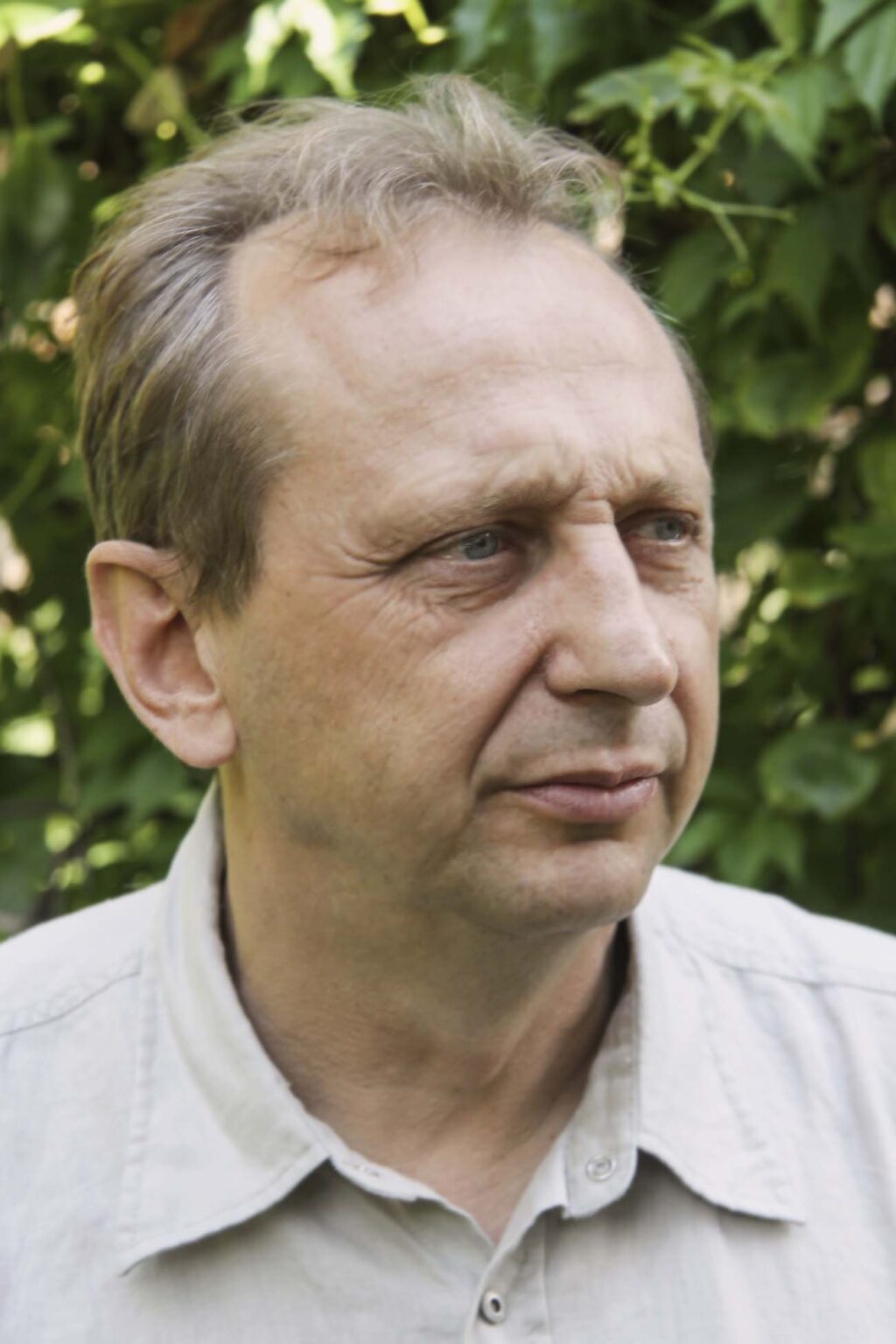
Robert Sobociński
Born in 1960 in Poznań, Poland. Graduated from the sculpture faculty at the Academy of Fine Arts in Poznań. He studied architecture at Poznań Polytechnic. He has created works for over 40 years. He has presented his works since the early 1980s, initially in Poland, then in West Europe: above all in France but also in Germany, Belgium, Holland, Great Britain and recently in Lithuania.
“Inspiration, nobleness: these could be the first definitions of the works of Robert Sobociński, who makes the created forms swirl, imagines them until he forgets about the density of bronze that he makes them with. This amazing world refers to cocoons that butterflies leave behind, to mutation, to placenta. (…) Robert Sobociński’s bronze, melting like wax, preserves the reflection of the body that freed itself from its earthly heaviness to join the ball of ghosts. The enlivening and melancholic shape is above all a solid recollection of a body, a memory of the performed work, an allegory of the necessary effort, a prelude to each created form. Robert Sobociński materialises successful escapes”.
SOBOCIŃSKI or Branding in Chaos
Robert Sobociński puts millennia to a halt. He comes from afar and from above. In his art of black magic and strong possession, he starts off with fundamental themes and then throws in a key of multiple codes. The shapes, crawling and winding or upright and slender, mix and merge with one another. They forget the delineated route and transport the viewer towards the disturbing and puzzling roads of uncertainty.
*******
Sobociński has the soul of sorcerers and shamans. He invokes the bronze artists of Luristan and succumbs to their imagination, full of illusions and lunacy. He extracts gigantic creatures emerging from the deep. An air of imminent catastrophe seems to surround the sculptures, while some formidable force, lurking in the bronze matter and brutally released, appears to ascend to conquer the sky.
And they appear – the inconceivable ones – like a spurting geyser.
*******
There is nothing more but an external theme, a faltering chrysalis of a dismembered and multiplied body, feeding on all the universe’s illusions. In Sobociński the element of absence is a creative element and strikes as a bolt of lightning a terrifying and perverse body that keeps up appearances. Exhumed from underground, his intensified sculpted forms, embracing with their tentacles and unstoppable, turn usable space upside down. Conquering the world, the skeletons that bear traces of infinity and stretch out, lead to the disappearance of our reference points that grant us a sense of security.
*******
This sculptor frees the mass of a sculpture of its weight. What remains is only a casing, bare remains, a hollowed casing, and a delicate skin of bronze… Thus we are dazzled by the miraculous presence of his big-sized sculptures.
When primordial tribal and archaic works make their way directly to the art of many cultures, it means that our answers have run aground and that our convictions are running out.
One cannot comprehend the universe by means of the mind only. And when the wave that shapes the minds stops spreading, something functions having no effect…
*******
Sobociński punctures the universe. He breathes with absence and the sultry limits of the obvious have become fragmented. The light of day has been touched by the disease of the time-to-come, and its abundant matter, burnt to the core, is feverish. The wind of utter lunacy tears up the hidden sides of knowledge and the order of culture becomes wiped out. Sobociński tears up space through matter. Through the holes in space he dissevers matter in order to transcend its limits. Carving wounds in bronze, he illuminates humanity’s scars. Opening up lacunae in the opaque, stirring the motionless, he rips our convictions to shreds. He puts the world in the midst of uncertainty.
Primitive writing of disfiguration. Truncated space.
*******
Sobociński puts to the test the demonic power of everyday prohibitions that have conquered our life and our emptiness. The order of sanctities becomes shaky and a life’s terror grips the soul by the throat. The fascinating cruelty of demons tames the ultimate caresses of phantoms and, tearing out of the dark, a chaos emerging out of a profound chasm is born.
Thus Sobociński claims the world for himself…
The everyday no longer has its foundations; the cruel and the sublime, intertwined with each other, spread unbound. One can see bits and pieces of rocks, thorns, fingernails, and shaky organs bearing a bizarre look of insects, while art wobbles.
*******
Sacrificing matter and branding skin. A sculpture endowed with a sex, extolled to a grand female arch. There is no distinction between man and animal, elements and ground, shells and skins… All the possibilities of what is intimate for the body, combining vital forces that share the universe, are present, moving, and ultimate.
And the earth is but an extensive sanctuary… Transformations reject the unacceptable matrix of identity and the status quo that can hardly breathe within existence.
In Sobociński, tardiness and rapidity enhance and contest each other. The time of decline comes short of reaching the terrifying ground level. Altitudes, however, offer resistance.
*******
Sobociński’s extraordinary syncretism, greatly diffused, depends on an extraordinary dissolution of being, on a lack of differentiating creative tensions. This is a high-risk sculpture, closer to the unknown and unnamable rather than to the universal and instantaneous. Each transformation destroys the initial closure and opens up to an invigorating otherness. A transforming being has neither memory nor age. It is neither obsessed with fulfillment nor yearns for a paradise lost. Artistic transformations are ephemeral and unique figures, from another place that is forever present and from a reality that remains in peril.
And thus sculpture dazzles space.
CHRISTIAN NOORBERGEN
Robert Sobociński Rozkwitanie form
Pochodzący z Polski, Robert Sobociński przedstawia swoją piątą wystawę w Paryżu. Jego rzeźba wywodząca się z esencji baroku rozwija się przez ciągłe przeobrażenia. Mineralna, kwiecista, organiczna, promienieje niepokojącym rozkwitem form antropomorficznych. Na przemian liany i macki, przez ruch odśrodkowy wsłuchując się w rozpaloną wyobraźnię, próbują zawładnąć przestrzenią .
Rzeźba prowadzi z sobą dialog poprzez odnawiającą się ciągłość formy. Sobociński pracuje pobudzony przez intuicję, która prowadzi go do działania w świecie metaforycznym, w którym lubi uwypuklać ambiwalencję. Wyobrażenie i przedstawienie nie jest dla niego sprzeczne. W dwóch wersjach rzeźby Demon, rzeźbie Taniec czy Wzlot obraz człowieka pozostawia swój ślad. Fragmenty kończyn zarysowują się na tle tułowia stanowiącego oś strukturalną, wokół której tryskają formy biologiczne. Podczas gdy jego najnowsze rzeźby rozwijają się w spirale charakterystyczne dla artysty, jego liryzm złagodniał na rzecz zakorzenienia, którym próbuje zażegnać walkę z ogromną siłą nieważkości.
Odlewane w jego poznańskiej pracowni techniką wosku traconego brązy uszlachetnione są patyną, której Sobociński zgłębił wszystkie alchemiczne tajniki. Zachowują one ciśnienie walki z materią i opanowanie swej oryginalnej gwałtowności, aby zakląć czas.
LA GAZETTE DE L’HÔTEL DROUOT – 12 STYCZNIA 2007 NR 2
Twenty Years
Twenty Years Your pencil draws an arch. You say, “This is the simplest, first sign of life”. The arch transforms into a circle which subsequently grows bigger, pursuing its arch. After each change the energy increases. The stroke is swift, sweeping yet elegant. The vitality of the hand revealed in this way transforms itself into an independent being.
The structure of construction, plaster and pencil again: you mark on a plane new lines of forces, meant to become a wax network and then a bronze sculpture. This is how a work is born: you called it “Nest” (2002), “Time” (1994), or “Whirlpool” (1998). It is more a history of waves than of sources; the object which you create in this way exemplifies the phenomenon of growth.
Sculptures impersonate the magic of growth. Without a beginning and an end, they extol transformations, provoke the coming to life. In this manner they transmit energy, but also a sense of proximity.
You say, “I seek archaic biological forms”. At the beginning you did not create either a black hole or a definite point but the “Arch” (1990): a simple and bow-shaped module, manifesting its existence, capable of reaction. Action or reaction, attraction or rejection, which occurs in an uncontrollable way. Extension, growth, this is what counts. “Turmoil” (2002), which you created in accordance with the same idea, assuming it would be exhibited flat on the ground, is covered with a relief shaped like bulbs that foreshadow germination. An absolute imperative of development and growth governs each of your decisions. Even the “Small Venus” (1991-1994) sprouts buds all over, a manifestation of fertility.
“I seek movement characteristic of plants, which expand in all directions, thus disintegrating form”, you explain in reference to your most recent works (“Arche”, 2003). Strange rhizomes that embody in a perfect way the need for growth and at the same time for anchorage.
Twenty years ago, observing closely, you began to study the phenomenon of construction and destruction, protection and sterility; you also noticed that excessive covering leads to suffocation. You entitled one of your first monumental projects the “Great Cuirass” (1986). You covered with leather or cast iron abstract forms made of cement or forgotten everyday objects. In this way was made “Renewed Animal” (1985) or the “Vehicle” (1985). The latter, filled with earth, ash and bread, is a sort of storehouse of its times, and is characteristic of the Polish art of the 1980s.
Time, then, became sealed. “I was confident that since always I had been going in a defined direction, but I did not know what the direction was. In 1985 I created ?Earth?, throwing a heavy stone against a sheet which was deformed by the impact.
Later I completed the ?Storehouses of the Earth? project, meant for Silesia, the most contaminated region in entire Poland”.
The interest you exhibited at this period in the surface of form as a force that unites and collects, became one of the signature elements of your works. The objects which you later made of bronze have the same form of a “receptacle”, out of which, however, metal has partly leaked. Pitted with ruptures and cracks with a Romantic drawing, it forms a titanic lace.
“Form remains open”, you claim in reference to such works as “Whirlpool” (1998), “Icon” (1993), “Returning” (1991), “Stranger” (1992), “Crouched” (1993), or “Fall” (1995) and “Somersault” (1996). You say, “Structures matter more than sculptures”. You have envisaged this mutation of forms so frequently that it bore fruit in a creative reflection. There is no reason for a work to be confined. This was demonstrated convincingly through Cézanne’s search for infinity. And since still in the 19th century Victor Hugo maintained that beauty “to a limited extent only can remain unlimited by outlines”, today you bind infinity and bring to life witnesses to the zones of turmoil and power.
In an effort to define the “Grand Spiral” (1990) you entered the entrails of a hollow form in order to shape it from inside, delicately, with the help of a simple tool – stone. Locating yourself physically inside the sculpture being created you provided it with breath. You often do this. This was also the case when you were creating “Life” (1993). “The question about the dialogue between structure and its axis has always tormented me”, you recall your intensive sense of power which such close proximity to form brought about.
“I like Paleolithic drawings that represent animals placed one on top of another”. If transformations and metamorphoses constitute one axis of quest, it means that this is a different way of your struggle with closure or imprisonment. Rapidly in search of changes, your sculptures begin with the “hand”, and finish with a “river” (“The Styx”, 1987). “Pegasus” (1991) originates in the “fish” and the “Unicorn” (2003) you have just created seems to confirm that. You like to capture the moment when the amorphous state becomes symbolic. There is nothing better than the alloy of bronze in which you create. It suits well your rejection of stability.
“People did not invent bronze. It is bronze that found them”, you say. It is true that the power of this privileged material occupies an important position in your world. It is an equal partner that you listen to, accompany, but also direct. “Aiming at close-knit mass is the nature of bronze. The mind, interfering with this process, creates form – a sculpture. An absolute control of metal would mean a search for the effect such as the statue of Apollo, polite and decorative. A partial control, in turn, allows for a preservation of dialogue”.
“Everything cannot be controlled”, you argue besides in reference to “Chaos” (2002). The same concerns the “Grand Arch” (2002), a kind of composition which does not oppose a classical work but which escapes from it into the area between the two planes, in which “everything” does not mean “being everything”, in which it is a sculpture all the same.
One should not oppose the tradition of the genre. You let us see, touch, circle, penetrate, and refresh our contact with this tradition, not betraying it. Some have announced the end of working in bronze. It so much defied today’s connotations. Confirming and showing closure, you succeed in liberating it, providing a new definition of contemporary sculpture: Energizing. Open. Ambitious. And this has been going on for twenty years. You cannot possibly stop at that. Arch after arch, metamorphosis after metamorphosis, you continue to fascinate us. And so we will meet in twenty years. All the best for your anniversary.
Françoise Monnin Françoise Monnin
The artist’s statements were collected in Paris
in November 2003
Bogowie w strzępach
For Nora, Silvia and Don Francisca,
who have made it possible for me to write this text
If I wanted to get rich, I would immediately stop being an art critic. If I really wanted to get extremely rich, in a short time at that, and if I had no scruples about it, I know well what I would do: I would become a founder of a religion or at least a sect. Nothing functions better nowadays and I immodestly believe that I am predisposed for it.
If, then… But it is not enough to establish a cult; one needs to create gods and erect temples. My cult would be based on polytheism (faith in one God is more boring and thus does not sell so well). I would entrust the implementation of the project to two artists: I would ask Axel Cassel to make peaceful deities, those that sanctify the mystic and secret espousal of man with nature, twigs, seeds and their dreams. However, I have talked at length about Axel and will continue to do so. I would commission the other artist – Robert Sobociński – to make tragic images, moving mausoleums, figures of all creatures and spaces that unsettle human consciousness… First, I think, I would commission him to make father Prometheus as he is being devoured by flames. I would like him to make numerous other gods struck by their own thunderbolts and maiming themselves with their own weapons – tragic deities which remind man that he cannot succeed in life without ruining his soul and that it is impossible to run until one becomes short of breath or, finally, to be dazzled when one is blind.
I would ask Robert to make rickety, unimaginable and indescribable spiral altars, where dubious and indecisive sacrifices are performed – the only ones we are capable of nowadays.
No, the gods of our times are not completely dead as was prematurely proclaimed by Nietzsche; they might be quite crisp but they are in tatters, ripped apart, with decorative scars of gnashes, scratches or grazes. Not only have they been crowned with thorns, but also clothed in splinters only to be brutally exposed later.
Robert Sobociński – in my judgement – is the only artist who is capable of creating today Rodins in tatters, ragamuffins in bronze, one of the most dense and massive matters that there are. He can fray it, tear, gnash, or rip to shreds, precisely and meticulously and at the same time violently and brutally. His gods, heroes and demons are all built of scars or slashes. Thanks to him one can see at first glance that the space of the solid is permeated with an acid that corrodes and torments until the unstable and shaky core. This is a sculpture damaged by a space contaminated with acid rains and our bitter tears. In the era of emptiness, in order for our idols to become clearly seen, they must be grooved. And Robert, one of its kind, is a sculptor who primarily works with the void.
Furthermore, knowing that he is also an architect, I would ask him to erect temples which would protect the Pantheon, both terrifying and ruined. “I will build you a city of tatters”, wrote recently Henri Michaux. I know that Robert Sobociński is capable of doing this. He would create for us pantheons of cobwebs, pyramids of moss and lichens, Angkors of double shell byssus. There would resound and be heard the last mumblings of pitiful requests and desperate prayers.
Gérard Barrière
7 April 2004
Nieuniknioną konsekwencją liberalnej i pragmatycznej wyobraźni, która zastąpiła zrozumienie w sensie krytycznym jest niebezpieczne balansowanie sztuki dzisiejszej na granicy niebytu i nieokreśloności. Nietzsche’ańska postać artysty w progu galerii luster nie jest osamotniona w tej modernistycznej grze – odpowiada jej spojrzenie widza, znieczulone przez modę na niedookreśloność. Jednakże czasem jeszcze zdarzają nam się spotkania, przy których zdejmujemy nasze soczewki, zbieramy pozytywną energię i stajemy się wrażliwi na dzieło, nie głoszące tryumfującej Sztuki czy Myśli. Dzieło Roberta Sobocińskiego jest często dziedzictwem pewnej szczególnej, odosobnionej myśli, wyłaniającej się jak gdyby ze świata Zmarłych i Historii, myśli którą można zrozumieć i przekazać tylko w jej niemocy, myśli stającej do z góry przegranej walki z nicością teraźniejszości. Szumią w tych spotkaniach przypływy istot, jak głosy w teatrze Beckett’a. (…)
Formy nie odczytuje się po to, by identyfikować ją z inną, istniejącą w rzeczywistości; wszelkie podobieństwo jest zakłócone przez inny atawizm, inne prawo rozwoju gatunków i materii.
Jednocześnie nic nie jest nam zupełnie obce ani obojętne, jednakże sposób poznawania zdaje się łączyć z sobą, bez różnicy, wszystkie domeny życia. Zdaje się, jakby monumentalna “Spirala”, brąz o poszarpanym końcu, znalazła w sobie roślinną siłę by uwolnić się ze stopu miedzi z cyną i wystrzelić w górę – wokół osi próżni.
Postacie mężczyzn: Ikar, Powracający, Obcy są już tylko plecionkami z brązu, ostateczną pamięcią ciała, już unicestwionego, lecz w które przestrzeń zdała się tchnąć nowy oddech. Być może ciała, które pokonały własną śmierć powstały z tego samego materiału co wyobraźnia? (…)>
Podczas twórczych poszukiwań, dążących do zbliżenia form obcych lub dalekich Naturze rzeźbiarz pragnie stworzyć swoje własne formy, wynaleźć nowy absolut restytuujący mityczne i uniwersalne pojęcia Natury. Mit jednorożca czyha w tej metalurgicznej pracowni… l o ile ogień jest stanem idealnym do dokonania tej fuzji, nie należy lekceważyć zasadniczej roli przestrzeni jako czynnika ostatecznie definiującego i konstytuującego rzeźbę; wykańczającego i napełniającego ją humanizmem.
Alain Macaire
(fragmenty tekstu opublikowanego w Paryżu, 1993)
Tłumaczenie: Małgorzata Sepioł. Wiesława Kiełkowska
(fragments of the text published in the catalogue of the exhibition at MR Gallery, Poznań,1990)
(fragments of the text concerning the “Transis d’aujourd’hui” exhibition – Bar-le-Duc, 2000,)